
Astronomers have confirmed the existence of a real-life three-body star system that exhibits a configuration far more peculiar than the celestial mechanics imagined in science fiction. At the core of this cosmic arrangement sits a millisecond pulsar, a highly dense, collapsed remnant of a dead star…
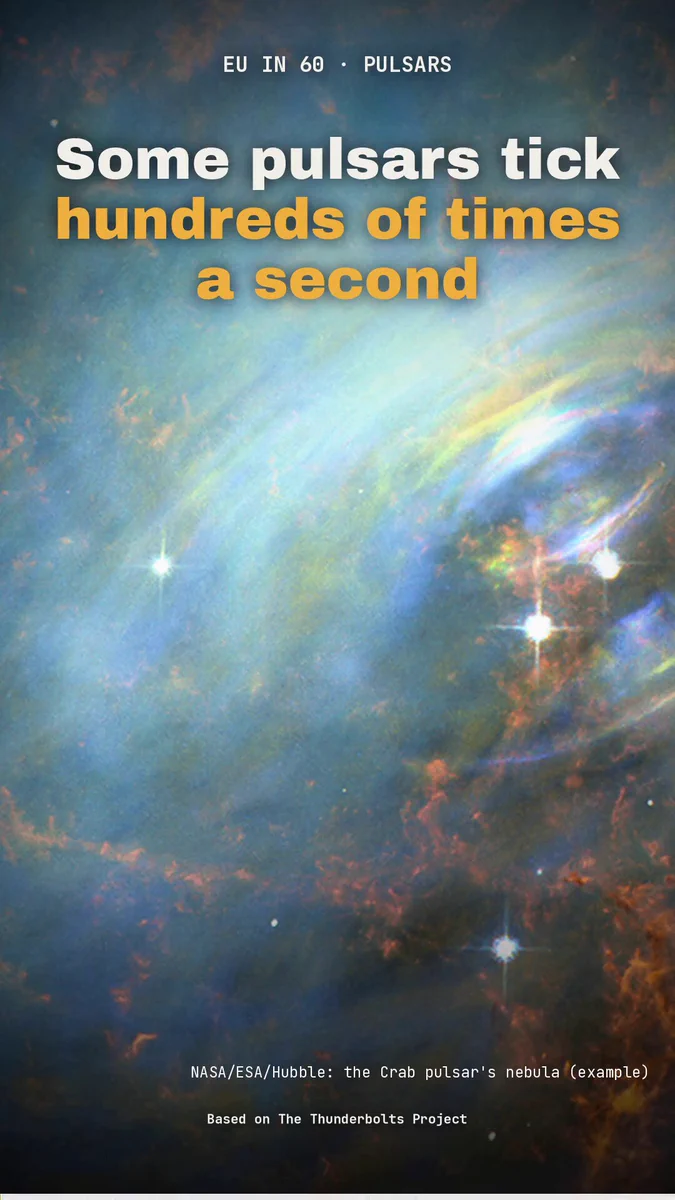
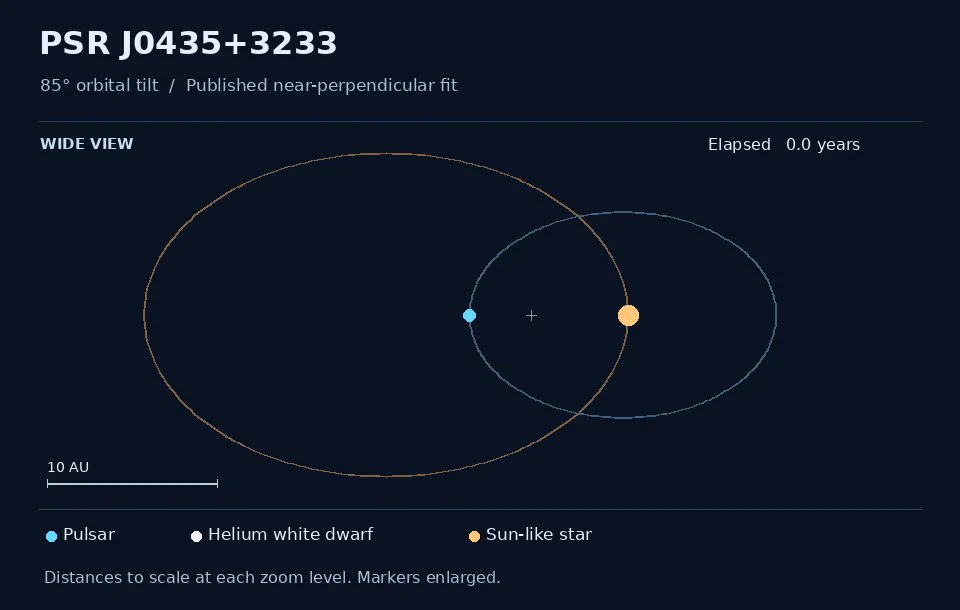
Massimo @Rainmaker1973 Astronomers have confirmed the existence of a real-life three-body star system that exhibits a configuration far more peculiar than the celestial mechanics imagined in science fiction. At the core of this cosmic arrangement sits a millisecond pulsar, a highly dense, collapsed remnant of a dead star that rotates over 300 times every second, or once every 3.2 milliseconds. As it rotates, it continuously sweeps a highly directional beam of radio waves across the cosmos, crossing Earth's line of sight with clockwork regularity. Using the Five-hundred-meter Aperture Spherical radio Telescope (FAST), the largest single-dish radio telescope in the world, a research team at the National Astronomical Observatories of the Chinese Academy of Sciences (NAOC) tracked the pulsar, cataloged as PSR J0435+3233. Their long-term observations revealed that the rapidly spinning pulsar is locked into a tight binary configuration with a helium white dwarf, completing a mutual orbit every eight days. This entire inner pair is further orbited by a more distant, unevolved, Sun-like G-type star moving along an elongated, highly eccentric trajectory that spans roughly 73 years. This rare arrangement marks only the second confirmed hierarchical triple stellar system containing a pulsar where planets are absent. While the fictional universe penned by Liu Cixin depicts a chaotic and unpredictable three-sun architecture, this real-life system maintains a stable orbital hierarchy. Crucially, the gravitational pull exerted by the outer, third star provides a definitive explanation for why the pulsar's rotational braking rate is shifting roughly 100 times faster than structurally isolated pulsars of a similar class. Because millisecond pulsars emit pulses with extreme precision, functioning effectively as natural interstellar timekeepers, this stable three-body system provides an exceptional laboratory for testing gravitational physics and evaluating specific boundaries within Albert Einstein's theory of general relativity. [Yuan, M., Chen, H., Yan, W., Lu, J., Xu, R., & Han, J. L. (2026). The PSR J0435+3233 Triple System. The Astrophysical Journal Letters, 1010(1), L9. DOI: 10.3847/2041-8213/aeaa29] 3:40 PM · Nov 4, 2026 · 99.7K Views 44 165 1.3K 353 Massimo @Rainmaker1973 Astronomers have confirmed the existence of a real-life three-body star system that exhibits a configuration far more peculiar than the celestial mechanics imagined in science fiction. At the core of this cosmic arrangement sits a millisecond pulsar, a highly dense, collapsed remnant of a dead star that rotates over 300 times every second, or once every 3.2 milliseconds. As it rotates, it continuously sweeps a highly directional beam of radio waves across the cosmos, crossing Earth's line of sight with clockwork regularity. Using the Five-hundred-meter Aperture Spherical radio Telescope (FAST), the largest single-dish radio telescope in the world, a research team at the National Astronomical Observatories of the Chinese Academy of Sciences (NAOC) tracked the pulsar, cataloged as PSR J0435+3233. Their long-term observations revealed that the rapidly spinning pulsar is locked into a tight binary configuration with a helium white dwarf, completing a mutual orbit every eight days. This entire inner pair is further orbited by a more distant, unevolved, Sun-like G-type star moving along an elongated, highly eccentric trajectory that spans roughly 73 years. This rare arrangement marks only the second confirmed hierarchical triple stellar system containing a pulsar where planets are absent. While the fictional universe penned by Liu Cixin depicts a chaotic and unpredictable three-sun architecture, this real-life system maintains a stable orbital hierarchy. Crucially, the gravitational pull exerted by the outer, third star provides a definitive explanation for why the pulsar's rotational braking rate is shifting roughly 100 times faster than structurally isolated pulsars of a similar class. Because millisecond pulsars emit pulses with extreme precision, functioning effectively as natural interstellar timekeepers, this stable three-body system provides an exceptional laboratory for testing gravitational physics and evaluating specific boundaries within Albert Einstein's theory of general relativity. [Yuan, M., Chen, H., Yan, W., Lu, J., Xu, R., & Han, J. L. (2026). The PSR J0435+3233 Triple System. The Astrophysical Journal Letters, 1010(1), L9. DOI: 10.3847/2041-8213/aeaa29] 3:40 PM · Nov 4, 2026 · 99.7K Views 44 165 1.3K 353 Plasma Based @cryptophry Nov 5 A pulsar ticking every 3.2 milliseconds, with two companions tugging on it, is a precision clock in the sky. The Thunderbolts Project argues pulsars aren't spinning stars at all, but electrical oscillators: plasma circuits discharging on a beat. ⚡ 00:00 1 14 2.4K David Melone @snaggle Nov 6 Wanted to try to get a visualization of this. This was just a few minutes on ChatGPT GIF 2 14 861 fity.eth @Fityeth Nov 4 A millisecond pulsar running a three body system. Reality wins again. 2 11 2.8K








Kedar: I wish you good luck in a country which becomes Islamic day after day. And when you look for asylum, Israel will be your asylum. Moser: I'm not afraid of Muslims... We see who bombed Iran. We see who bombed Lebanon... We see what happened to Gaza. https://t.co/BDm0orCjl0




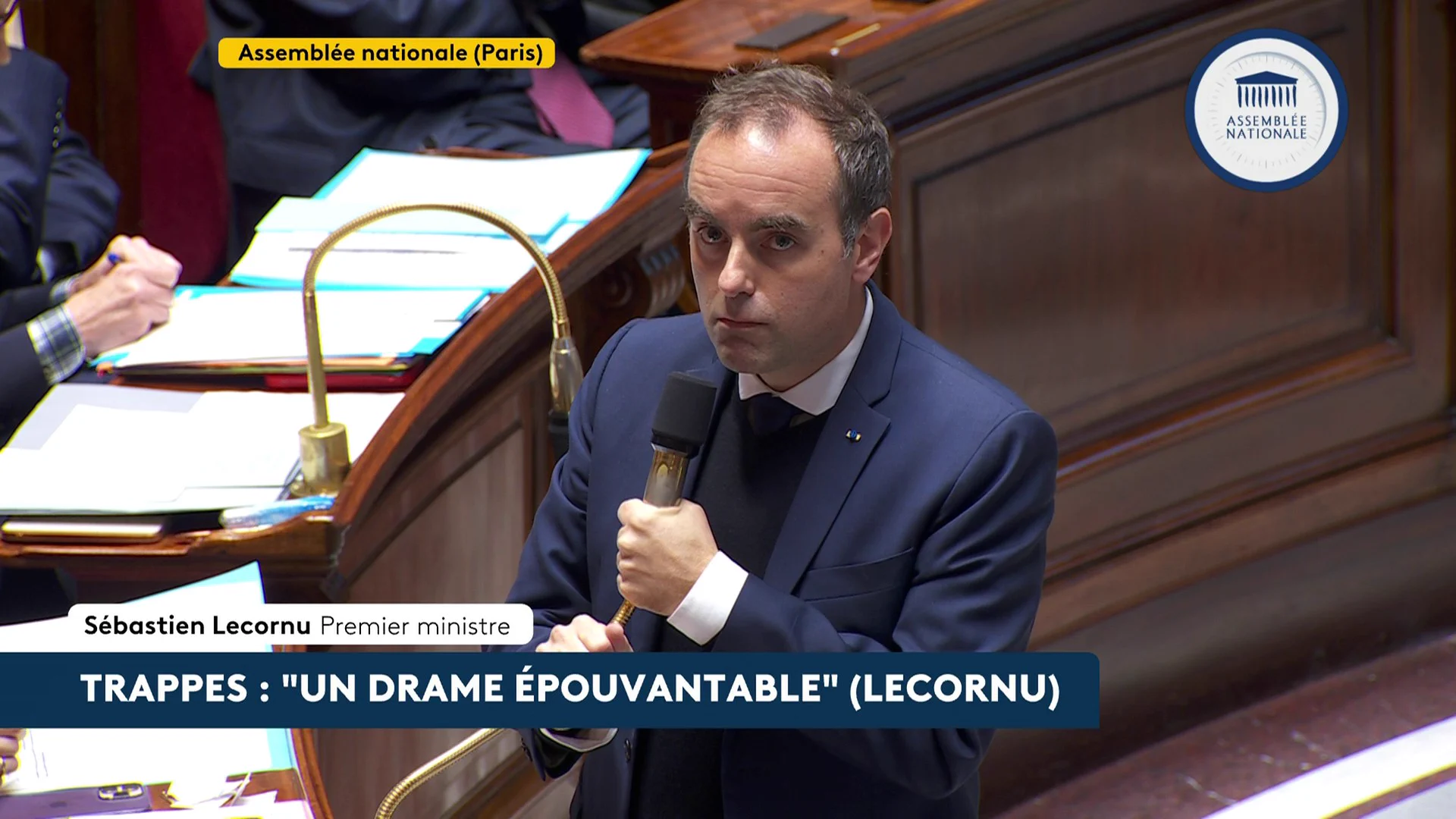
QUEL SCANDALE Dans son discours d’hommage aux victimes de l’attentat de Trappes, Sébastien Lecornu a OSÉ mentionner Quentin Deranque, affirmant qu’on ne pouvait pas opposer les morts. Quentin Deranque avait adopté une idéologie raciste et néonazie. Cette idéologie est la même


Migrer sur #Mastodon, c’est reprendre collectivement le contrôle sur nos données personnelles et sur internet. C’est œuvrer pour un monde libertaire, égalitaire et solidaire.
Les grandes plateformes capitalistes d’aujourd’hui (comme les Gafam) recréent artificiellement un modèle de réseau centralisé par-dessus le web pour se rendre indispensables, forcer les échanges à passer par elles, et ainsi en tirer profit.

À l’inverse de l’architecture de ces plateformes, il existe une architecture totalement décentralisée où chaque personne héberge ses données sur son ordinateur et dispose d’un logiciel pour se connecter au réseau correspondant. C’est le principe des réseaux P2P (comme BitTorrent)

En opposition à ces deux modèles se sont développées des plateformes acentrées, basées sur des logiciels libres non-commerciaux tels que Mastodon et PeerTube (respectivement des alternatives à Twitter et YouTube)
https://joinpeertube.org/fr_FR/
Pour faciliter l’accessibilité, le choix retenu a été celui d’une architecture fédérée où existent une multitude de serveurs (ou instances) à but non-lucratif et reliés entre eux, qui permettent d’héberger les données personnelles et d’accéder au réseau via une simple inscription

C’est en quelque sorte le modèle des communes insurrectionnelles de 1871 appliqué à Internet. Le communalisme instaurait une nouvelle organisation de la République française basée sur la démocratie directe et le fédéralisme.
https://www.revue-ballast.fr/la-commune-et-ses-usages-libertaires/
C’est un modèle également très proche du municipalisme de Murray Bookchin
https://www.revue-ballast.fr/le-moment-communaliste/
Comme le logiciel est libre, n’importe qui disposant des connaissances pour le faire peut créer une instance et ainsi permettre aux citoyens•nes de se connecter au réseau et d’échanger avec l’ensemble des utilisateurs•trices de Mastodon.
Avec le modèle fédéré, aucune instance ne peut se rendre indispensable et contrôler le réseau à elle seule tant qu’il n’y a pas d’instance incontournable car devenue trop grosse (en terme de nombre d’utilisateur•trices).
Les instances ayant atteint un grand nombre d’utilisateurs, comme mastodon.social, framapiaf.org ou marmot.fr, ont tendance à fermer leurs inscriptions, tandis que d’autres instances ouvrent au fur et à mesure que de nouveaux utilisateurs arrivent.
Le modèle non marchand de ces plateformes alternatives ne les incite pas à rendre captifs leurs utilisateur et utilisatrices. Au contraire, gérer une énorme instance est particulièrement couteux, et sans source de revenu autre que des dons, elles sont incitées à rester petite.
Le choix d’une instance détermine l’identifiant complet (sous la forme @nom@instance), les règles auxquelles vous êtes soumis, et les messages qui apparaissent sur le fil local (il y aussi un fil perso (vos abonnés) et un fil global (utilisateurs de toutes les instances)).

Votre instance peut choisir avc qui elle se fédère et peut bannir des instances qui ne conviennent pas au groupe. D’où l’importance de bien choisir une instance adaptée à ses idéaux et à ses intérêts, ce qui permet d’évoluer dans un environnement à la fois ouvert et sécurisé.
Tuto s’inscrire (autogéré) https://mypads2.framapad.org/p/twitter-mastodon-9c2lz19ed
Tuto s’inscrire https://www.blog-nouvelles-technologies.fr/244863/comment-utiliser-mastodon-une-alternative-twitter/
Tuto changer d’instance https://fediverse.blog/~/BlogDHeyla/Changer%20d'instance%20Mastodon/
Quelques instances francophones ouvertes aux inscriptions :
http://piaille.fr/ (par @vincib)
http://social.sciences.re/ (universitaires)
http://eldritch.cafe/ (anarchiste)
http://pipou.academy/ (queer)
http://mastodon.mim-libre.fr/ (Agents de l’Etat)
D’autres instances ici :
https://nitter.slipfox.xyz/framasoft/status/1511614889089019907#m
A l’intérieur de Mastodon, les instances sont donc reliées entre elles. De plus, contrairement aux logiciels des Gafam, Mastodon est relié à d’autres logiciels libres : il est par exemple possible de suivre une chaine PeerTube depuis un compte Mastodon
La galaxie d’instances fédérées et l’univers des logiciels libres intercompatibles est appelée le fédiverse (de l’anglais fediverse, mot-valise pour federated universe). https://fediverse.party/
Dans le fediverse, il n’y a ni pub, ni recommandations dictées par des algorithmes, ni business avec vos données personnelles. On y trouve :
Mastodon (alternative à Twitter)
Peertube (alternative à YouTube)
Pixelfed (alternative à Instagram)
Diaspora (alternative à Facebook)
Lemmy (alternative à Reddit)

Les logiciels libres sont conçus pour défendre le libre accès à la connaissance, le respect de la vie privée ainsi que la neutralité et la diversité du web. Ils court-circuitent le penchant naturel du Capital et de l’État à profiter, à contrôler et à valoriser le fascisme.

Sources
@p4bl0 pour #AL (@UnionCoLib)
https://www.unioncommunistelibertaire.org/?Reseau-Comprendre-le-fediverse

Interview d’Eugen Rochko, fondateur de Mastodon (et administrateur de l’instance mastodon.social) par @TIME : time.com/6229230/mastodon-eu…
Eugen Rochko a forgé un outil numérique permettant de remettre démocratiquement l’extrême droite à la place qui lui revient : les égouts.


Retour d’expérience, par @Affordanceinfo2 : https://affordance.framasoft.org/2022/11/le-mastodonte-et-loiseau-bleu/
Tuto - Fil Twitter : s’inscrire et utiliser Mastodon
https://nitter.slipfox.xyz/a_berut/status/1587748363348344832#m
Un fil qui dresse un parallèle entre logiciels libres et semences paysannes et qui explique comment Mastodon permet d’évoluer dans un environnement numérique à la fois plus ouvert et plus sécurisé (par rapport à la haine en ligne) que sur les plateformes capitalistes.
https://nitter.slipfox.xyz/nourrirlemonde/status/1589280361158414336#m