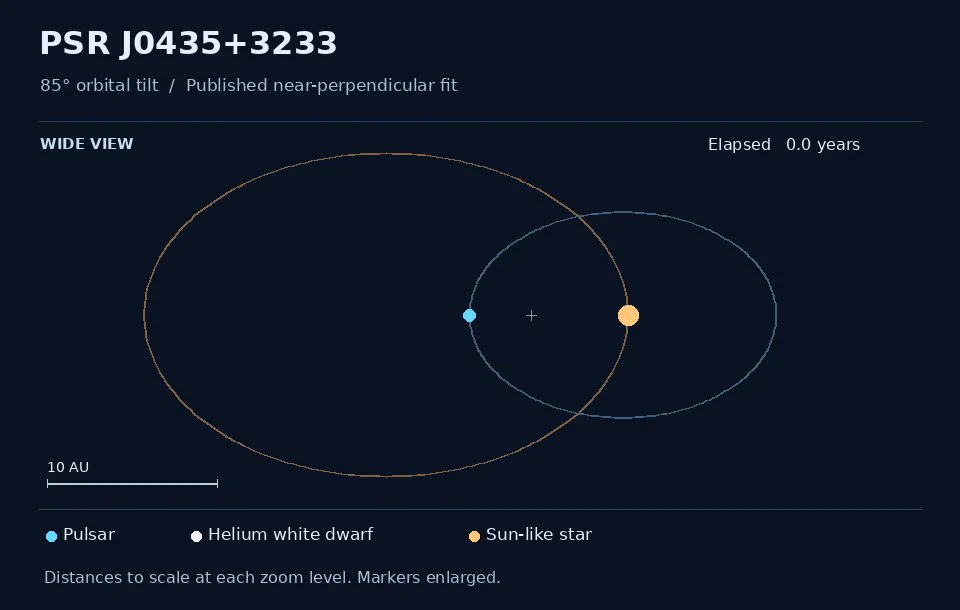
Astronomers have confirmed the existence of a real-life three-body star system that exhibits a configuration far more peculiar than the celestial mechanics imagined in science fiction. At the core of this cosmic arrangement sits a millisecond pulsar, a highly dense, collapsed remnant of a dead star…
Massimo @Rainmaker1973 Astronomers have confirmed the existence of a real-life three-body star system that exhibits a configuration far more peculiar than the celestial mechanics imagined in science fiction. At the core of this cosmic arrangement sits a millisecond pulsar, a highly dense, collapsed remnant of a dead star that rotates over 300 times every second, or once every 3.2 milliseconds. As it rotates, it continuously sweeps a highly directional beam of radio waves across the cosmos, crossing Earth's line of sight with clockwork regularity. Using the Five-hundred-meter Aperture Spherical radio Telescope (FAST), the largest single-dish radio telescope in the world, a research team at the National Astronomical Observatories of the Chinese Academy of Sciences (NAOC) tracked the pulsar, cataloged as PSR J0435+3233. Their long-term observations revealed that the rapidly spinning pulsar is locked into a tight binary configuration with a helium white dwarf, completing a mutual orbit every eight days. This entire inner pair is further orbited by a more distant, unevolved, Sun-like G-type star moving along an elongated, highly eccentric trajectory that spans roughly 73 years. This rare arrangement marks only the second confirmed hierarchical triple stellar system containing a pulsar where planets are absent. While the fictional universe penned by Liu Cixin depicts a chaotic and unpredictable three-sun architecture, this real-life system maintains a stable orbital hierarchy. Crucially, the gravitational pull exerted by the outer, third star provides a definitive explanation for why the pulsar's rotational braking rate is shifting roughly 100 times faster than structurally isolated pulsars of a similar class. Because millisecond pulsars emit pulses with extreme precision, functioning effectively as natural interstellar timekeepers, this stable three-body system provides an exceptional laboratory for testing gravitational physics and evaluating specific boundaries within Albert Einstein's theory of general relativity. [Yuan, M., Chen, H., Yan, W., Lu, J., Xu, R., & Han, J. L. (2026). The PSR J0435+3233 Triple System. The Astrophysical Journal Letters, 1010(1), L9. DOI: 10.3847/2041-8213/aeaa29] 3:40 PM · Nov 4, 2026 · 99.7K Views 44 165 1.3K 353 Massimo @Rainmaker1973 Astronomers have confirmed the existence of a real-life three-body star system that exhibits a configuration far more peculiar than the celestial mechanics imagined in science fiction. At the core of this cosmic arrangement sits a millisecond pulsar, a highly dense, collapsed remnant of a dead star that rotates over 300 times every second, or once every 3.2 milliseconds. As it rotates, it continuously sweeps a highly directional beam of radio waves across the cosmos, crossing Earth's line of sight with clockwork regularity. Using the Five-hundred-meter Aperture Spherical radio Telescope (FAST), the largest single-dish radio telescope in the world, a research team at the National Astronomical Observatories of the Chinese Academy of Sciences (NAOC) tracked the pulsar, cataloged as PSR J0435+3233. Their long-term observations revealed that the rapidly spinning pulsar is locked into a tight binary configuration with a helium white dwarf, completing a mutual orbit every eight days. This entire inner pair is further orbited by a more distant, unevolved, Sun-like G-type star moving along an elongated, highly eccentric trajectory that spans roughly 73 years. This rare arrangement marks only the second confirmed hierarchical triple stellar system containing a pulsar where planets are absent. While the fictional universe penned by Liu Cixin depicts a chaotic and unpredictable three-sun architecture, this real-life system maintains a stable orbital hierarchy. Crucially, the gravitational pull exerted by the outer, third star provides a definitive explanation for why the pulsar's rotational braking rate is shifting roughly 100 times faster than structurally isolated pulsars of a similar class. Because millisecond pulsars emit pulses with extreme precision, functioning effectively as natural interstellar timekeepers, this stable three-body system provides an exceptional laboratory for testing gravitational physics and evaluating specific boundaries within Albert Einstein's theory of general relativity. [Yuan, M., Chen, H., Yan, W., Lu, J., Xu, R., & Han, J. L. (2026). The PSR J0435+3233 Triple System. The Astrophysical Journal Letters, 1010(1), L9. DOI: 10.3847/2041-8213/aeaa29] 3:40 PM · Nov 4, 2026 · 99.7K Views 44 165 1.3K 353 Plasma Based @cryptophry Nov 5 A pulsar ticking every 3.2 milliseconds, with two companions tugging on it, is a precision clock in the sky. The Thunderbolts Project argues pulsars aren't spinning stars at all, but electrical oscillators: plasma circuits discharging on a beat. ⚡ 00:00 1 14 2.4K David Melone @snaggle Nov 6 Wanted to try to get a visualization of this. This was just a few minutes on ChatGPT GIF 2 14 861 fity.eth @Fityeth Nov 4 A millisecond pulsar running a three body system. Reality wins again. 2 11 2.8K