Daily Shaarli
Yesterday - November 8, 2026
Le commissariat de police de Brest a ordonné à trois lycées de Brest (Finistère), concernés par des blocus depuis le début du mouvement lycéen, de lui fournir les trombinoscopes des élèves. Plusieurs syndicats craignent « un fichage de grande ampleur » et annoncent vouloir saisir la Commission nationale de l’informatique et des libertés (Cnil).

Astronomers have confirmed the existence of a real-life three-body star system that exhibits a configuration far more peculiar than the celestial mechanics imagined in science fiction. At the core of this cosmic arrangement sits a millisecond pulsar, a highly dense, collapsed remnant of a dead star…
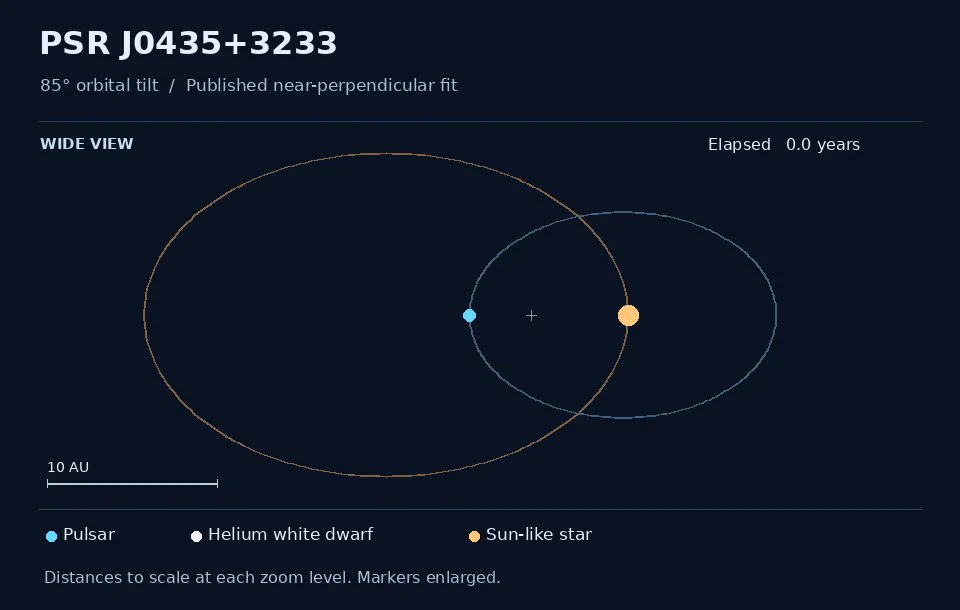
Massimo @Rainmaker1973 Astronomers have confirmed the existence of a real-life three-body star system that exhibits a configuration far more peculiar than the celestial mechanics imagined in science fiction. At the core of this cosmic arrangement sits a millisecond pulsar, a highly dense, collapsed remnant of a dead star that rotates over 300 times every second, or once every 3.2 milliseconds. As it rotates, it continuously sweeps a highly directional beam of radio waves across the cosmos, crossing Earth's line of sight with clockwork regularity. Using the Five-hundred-meter Aperture Spherical radio Telescope (FAST), the largest single-dish radio telescope in the world, a research team at the National Astronomical Observatories of the Chinese Academy of Sciences (NAOC) tracked the pulsar, cataloged as PSR J0435+3233. Their long-term observations revealed that the rapidly spinning pulsar is locked into a tight binary configuration with a helium white dwarf, completing a mutual orbit every eight days. This entire inner pair is further orbited by a more distant, unevolved, Sun-like G-type star moving along an elongated, highly eccentric trajectory that spans roughly 73 years. This rare arrangement marks only the second confirmed hierarchical triple stellar system containing a pulsar where planets are absent. While the fictional universe penned by Liu Cixin depicts a chaotic and unpredictable three-sun architecture, this real-life system maintains a stable orbital hierarchy. Crucially, the gravitational pull exerted by the outer, third star provides a definitive explanation for why the pulsar's rotational braking rate is shifting roughly 100 times faster than structurally isolated pulsars of a similar class. Because millisecond pulsars emit pulses with extreme precision, functioning effectively as natural interstellar timekeepers, this stable three-body system provides an exceptional laboratory for testing gravitational physics and evaluating specific boundaries within Albert Einstein's theory of general relativity. [Yuan, M., Chen, H., Yan, W., Lu, J., Xu, R., & Han, J. L. (2026). The PSR J0435+3233 Triple System. The Astrophysical Journal Letters, 1010(1), L9. DOI: 10.3847/2041-8213/aeaa29] 3:40 PM · Nov 4, 2026 · 99.7K Views 44 165 1.3K 353 Massimo @Rainmaker1973 Astronomers have confirmed the existence of a real-life three-body star system that exhibits a configuration far more peculiar than the celestial mechanics imagined in science fiction. At the core of this cosmic arrangement sits a millisecond pulsar, a highly dense, collapsed remnant of a dead star that rotates over 300 times every second, or once every 3.2 milliseconds. As it rotates, it continuously sweeps a highly directional beam of radio waves across the cosmos, crossing Earth's line of sight with clockwork regularity. Using the Five-hundred-meter Aperture Spherical radio Telescope (FAST), the largest single-dish radio telescope in the world, a research team at the National Astronomical Observatories of the Chinese Academy of Sciences (NAOC) tracked the pulsar, cataloged as PSR J0435+3233. Their long-term observations revealed that the rapidly spinning pulsar is locked into a tight binary configuration with a helium white dwarf, completing a mutual orbit every eight days. This entire inner pair is further orbited by a more distant, unevolved, Sun-like G-type star moving along an elongated, highly eccentric trajectory that spans roughly 73 years. This rare arrangement marks only the second confirmed hierarchical triple stellar system containing a pulsar where planets are absent. While the fictional universe penned by Liu Cixin depicts a chaotic and unpredictable three-sun architecture, this real-life system maintains a stable orbital hierarchy. Crucially, the gravitational pull exerted by the outer, third star provides a definitive explanation for why the pulsar's rotational braking rate is shifting roughly 100 times faster than structurally isolated pulsars of a similar class. Because millisecond pulsars emit pulses with extreme precision, functioning effectively as natural interstellar timekeepers, this stable three-body system provides an exceptional laboratory for testing gravitational physics and evaluating specific boundaries within Albert Einstein's theory of general relativity. [Yuan, M., Chen, H., Yan, W., Lu, J., Xu, R., & Han, J. L. (2026). The PSR J0435+3233 Triple System. The Astrophysical Journal Letters, 1010(1), L9. DOI: 10.3847/2041-8213/aeaa29] 3:40 PM · Nov 4, 2026 · 99.7K Views 44 165 1.3K 353 Plasma Based @cryptophry Nov 5 A pulsar ticking every 3.2 milliseconds, with two companions tugging on it, is a precision clock in the sky. The Thunderbolts Project argues pulsars aren't spinning stars at all, but electrical oscillators: plasma circuits discharging on a beat. ⚡ 00:00 1 14 2.4K David Melone @snaggle Nov 6 Wanted to try to get a visualization of this. This was just a few minutes on ChatGPT GIF 2 14 861 fity.eth @Fityeth Nov 4 A millisecond pulsar running a three body system. Reality wins again. 2 11 2.8K








Un journaliste se fait interpeller pour avoir demander un RIO.

En plein débat budgétaire, focalisé sur les dépenses pour mieux laisser le volet recettes dans l’angle mort, un texte vient jeter un pavé dans la mare en faisant la lumière sur les ...